

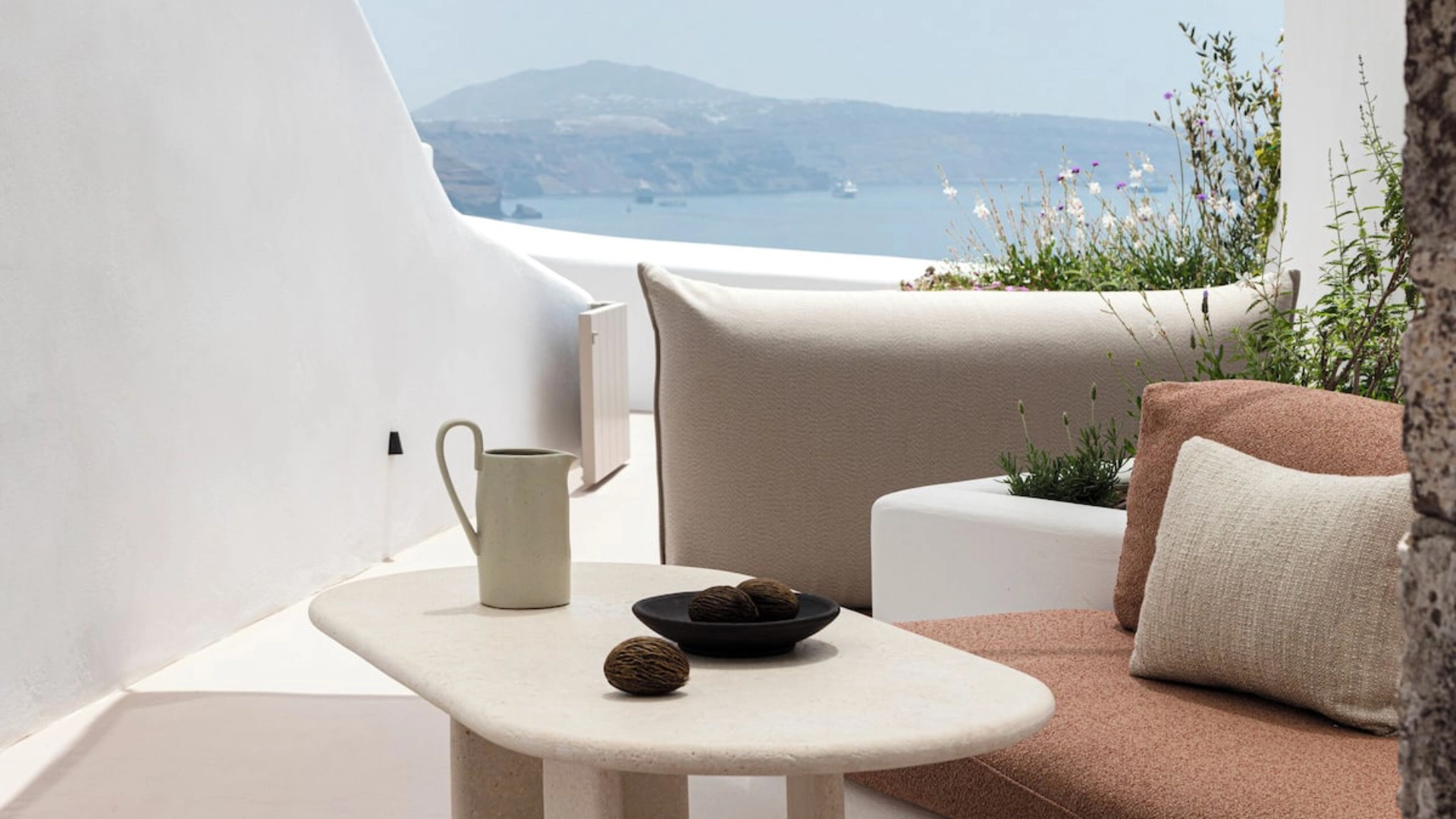
Across the Aegean Sea, the luminous villages of the Cyclades appear as if sculpted from light itself.
Whitewashed terraces, cubic volumes, and deep blue horizons define one of the world’s most recognizable architectural landscapes.
Within this environment, Cycladic architecture has evolved over centuries to respond intelligently to climate, topography, and Mediterranean lifestyles.
Today, designers and architects studying these island homes often discover that their greatest lesson lies not only in the buildings themselves, but in the spaces between them.
Terraces, shaded courtyards, and outdoor lounges form the heart of daily life, where residents gather, dine, and contemplate the surrounding sea.
In this context, luxury outdoor seating in Mediterranean homes becomes an essential design element — shaping comfort while preserving the understated elegance that defines the Cyclades.
For architects, interior designers, and global tastemakers, Cycladic island homes represent a masterclass in how architecture and outdoor living merge seamlessly.
Their terraces are not merely decorative platforms; they are extensions of the home, orchestrating views, breezes, and social rituals under the Mediterranean sun.
The Architectural Language of the Cyclades
At first glance, the visual language of the Cyclades may appear minimalist. Yet this simplicity is the result of centuries of adaptation to the island environment.
Cycladic architecture developed from practical considerations: limited resources, intense sunlight, strong winds, and steep coastal terrain.
Traditional houses were constructed using locally available stone, coated with lime plaster that reflects sunlight and naturally disinfects surfaces.
The cubic geometry of these homes is not merely aesthetic — it minimizes exposure to wind while allowing structures to cluster organically along the slopes.
Equally important are the terraces that surround these homes. Elevated platforms, outdoor staircases, and roof decks transform rooftops and courtyards into daily living areas.
These spaces provide ideal locations for luxury outdoor seating Mediterranean homes, where the boundary between architecture and landscape dissolves.

Key Characteristics of Cycladic Architecture
- Whitewashed masonry walls that reflect heat and amplify light
- Cubic, geometric volumes designed to resist strong island winds
- Flat roofs and stepped terraces used as outdoor living platforms
- Minimal ornamentation emphasizing proportion and material purity
- Integration with topography, allowing homes to cascade down hillsides
These defining features have influenced architects around the world, from modernist pioneers to contemporary luxury villa designers seeking timeless Mediterranean inspiration.
The Terrace as the Heart of Island Living
In the Cyclades, the terrace functions as the true living room of the home. Morning coffee, midday shade, and evening gatherings all unfold outdoors, framed by panoramic sea views and the rhythmic sound of wind across the landscape.
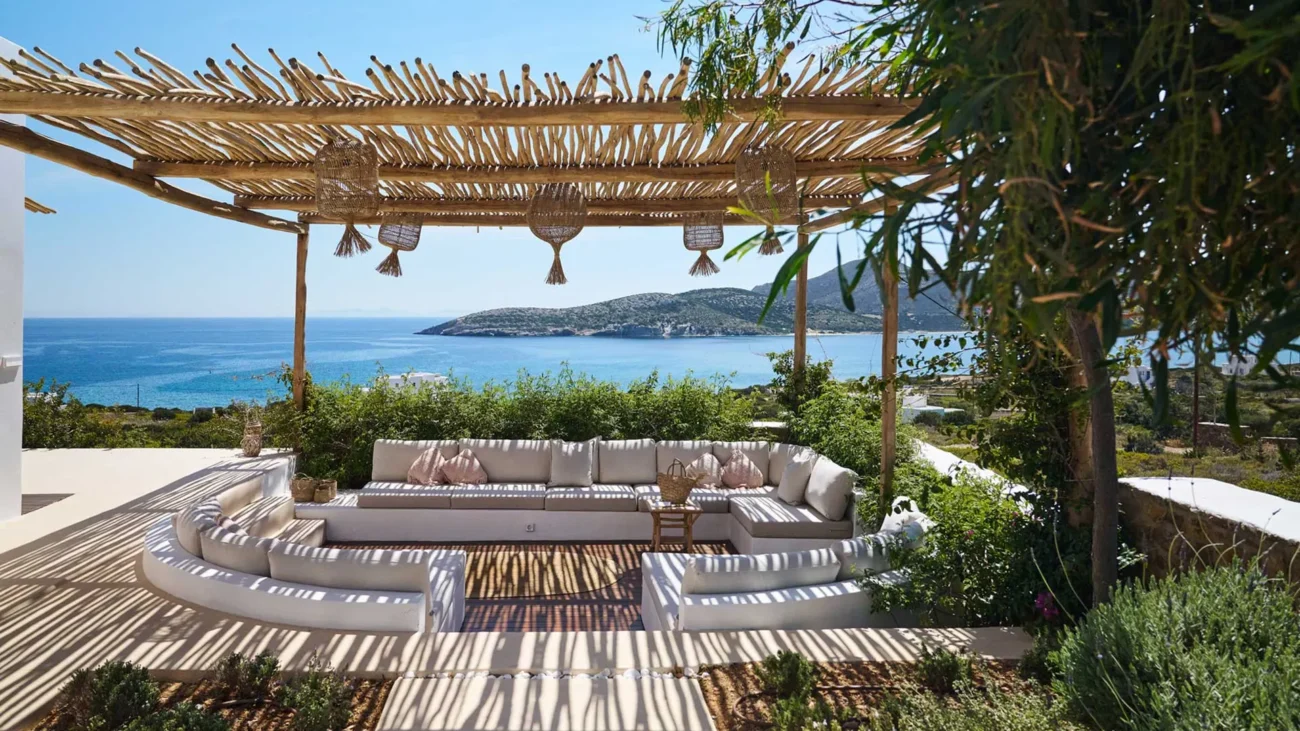
Because of this central role, terraces are carefully designed to balance exposure and shelter. Pergolas woven with reeds or timber slats filter the sunlight, while low masonry walls protect seating areas from the Meltemi winds that sweep across the Aegean during summer months.
Within these architectural frameworks, luxury outdoor seating Mediterranean homes is arranged with restraint and intentionality. The emphasis is not on excess furniture but on carefully chosen pieces that complement the sculptural simplicity of the environment.
Spatial Elements That Define Cycladic Terraces
- Built-in benches formed from masonry and finished in white plaster
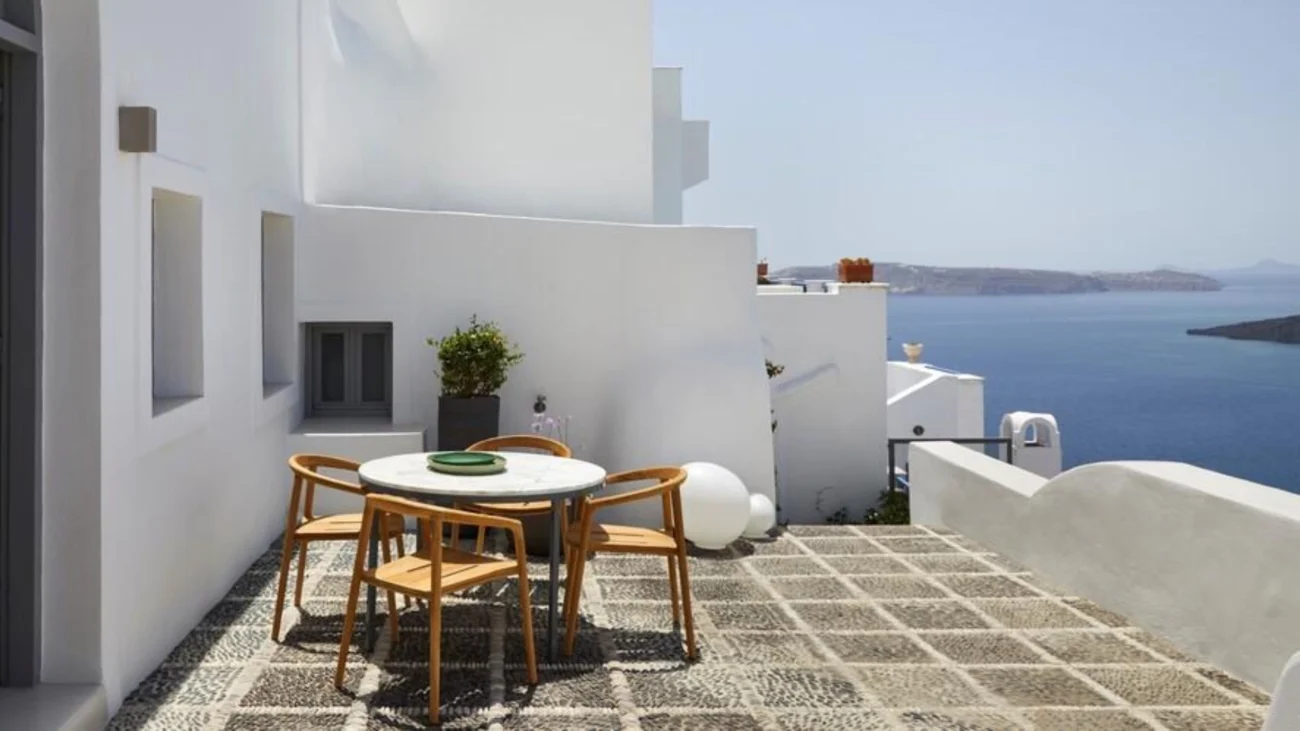
- Stone-paved patios that retain coolness during hot afternoons
- Low walls framing uninterrupted sea views
- Pergolas draped with linen or reed shading
- Layered seating areas positioned for sunset gatherings
These elements create an atmosphere where architecture quietly supports the rhythms of Mediterranean life.
The Aesthetic Philosophy of Whitewashed Terraces
The striking whiteness associated with Cycladic architecture has both historical and environmental origins. Lime-based coatings were traditionally used to maintain hygiene and reflect the intense Aegean sun, keeping interiors cool throughout the summer.
Over time, this functional material evolved into an aesthetic signature. Against the deep cobalt of doors and window frames, white surfaces amplify natural light and create a timeless visual harmony between architecture and landscape.
For outdoor spaces, this palette offers designers a powerful advantage: it allows furniture, textiles, and vegetation to stand out subtly without overwhelming the architecture. In luxury outdoor seating Mediterranean homes, neutral cushions, woven textures, and natural woods appear particularly refined against the luminous backdrop of white terraces.
Materials That Complement the Cycladic Palette
- Handcrafted teak or iroko wood furniture
- Neutral linen upholstery and cushions
- Woven rope or rattan seating elements
- Local stone flooring and built-in seating
- Terracotta or ceramic planters with olive trees or herbs
The result is a setting that feels both luxurious and deeply connected to the landscape.
Outdoor Seating in Cycladic Luxury Homes
In recent decades, the Cycladic islands have become a global destination for architectural experimentation and luxury real estate. Designers reinterpret traditional forms while maintaining the essential principles of Cycladic architecture.
One of the most significant evolutions lies in outdoor seating arrangements. Contemporary villas integrate expansive lounge zones, infinity-edge terraces, and modular seating systems that allow residents to adapt spaces throughout the day.
Yet despite these modern interventions, the spirit of restraint remains central. In the best examples of luxury outdoor seating Mediterranean homes, furniture remains low-profile and sculptural, preserving the dominance of the horizon and sky.
Design Principles for Cycladic Outdoor Seating
- Respect the view — seating should frame, not compete with, the landscape.
- Maintain architectural continuity — materials and colors should echo the surrounding structures.
- Favor modular flexibility — adaptable seating supports different social configurations.
- Prioritize comfort without visual weight — cushions and textiles add softness without clutter.
- Integrate shade solutions such as pergolas, canopies, or retractable fabrics.
These strategies ensure terraces remain serene environments while accommodating contemporary lifestyles.
The Cultural Significance of Outdoor Living in the Mediterranean
The prominence of terraces in Cycladic homes reflects a broader Mediterranean cultural tradition. Across Greece, Italy, and southern Spain, outdoor living has long shaped architectural design.
Meals stretch late into the evening, family gatherings unfold beneath pergolas, and daily life flows naturally between interior and exterior spaces. For this reason, luxury outdoor seating Mediterranean homes must support both social intimacy and quiet contemplation.
Architectural historians often highlight how this tradition influenced modern design movements, including Mediterranean modernism. A detailed exploration of these cultural influences can be found through organizations such as the
ArchDaily architecture platform, which documents contemporary interpretations of Mediterranean architecture.
In Cycladic settings, this cultural emphasis on outdoor life transforms terraces into stages for everyday rituals — from sunrise yoga to twilight aperitifs overlooking the sea.
Landscape, Light, and the Psychology of Space
One of the most compelling aspects of Cycladic architecture lies in its ability to choreograph light. Terraces are positioned to capture sunrise reflections across white surfaces, while narrow passageways create moments of shade and coolness during midday heat.
Outdoor seating areas are often placed strategically to capture the golden hour — when sunlight softens and the Aegean landscape takes on a warm, almost surreal glow. In this moment, the simplicity of luxury outdoor seating Mediterranean homes reveals its full impact.
Rather than competing with the environment, the furniture becomes part of the spatial composition — allowing architecture, light, and horizon to remain the true protagonists.
Lessons for Contemporary Architects and Designers
For professionals working in luxury residential design, Cycladic island homes offer enduring lessons in restraint and environmental intelligence.
Despite the rise of increasingly elaborate outdoor amenities, the most successful Mediterranean homes continue to prioritize simplicity, proportion, and connection to place.
Key Takeaways from Cycladic Design
- Simplicity creates timelessness. Minimal forms age more gracefully than trend-driven aesthetics.
- Climate-responsive architecture enhances comfort naturally.
- Outdoor spaces should function as true living rooms.
- Furniture must complement architecture rather than dominate it.
- Views, light, and landscape are the ultimate luxury.
In this sense, Cycladic architecture remains profoundly contemporary. Its principles align with modern sustainability goals while offering a timeless vision of Mediterranean living.
The Enduring Elegance of Cycladic Terraces
From the cliffs of Santorini to the quiet villages of Paros and Antiparos, the terraces of the Cyclades continue to captivate architects, designers, and global travelers. Their beauty lies not in ornamentation but in clarity: white walls, open skies, and spaces designed for human connection.
In these luminous environments, luxury outdoor seating Mediterranean homes becomes more than a matter of comfort. It is a design philosophy — one that respects landscape, celebrates simplicity, and elevates the art of outdoor living.
For contemporary design professionals and discerning homeowners alike, Cycladic island homes offer a timeless reminder that the most extraordinary luxury often lies in the quiet dialogue between architecture, nature, and the Mediterranean sun.