

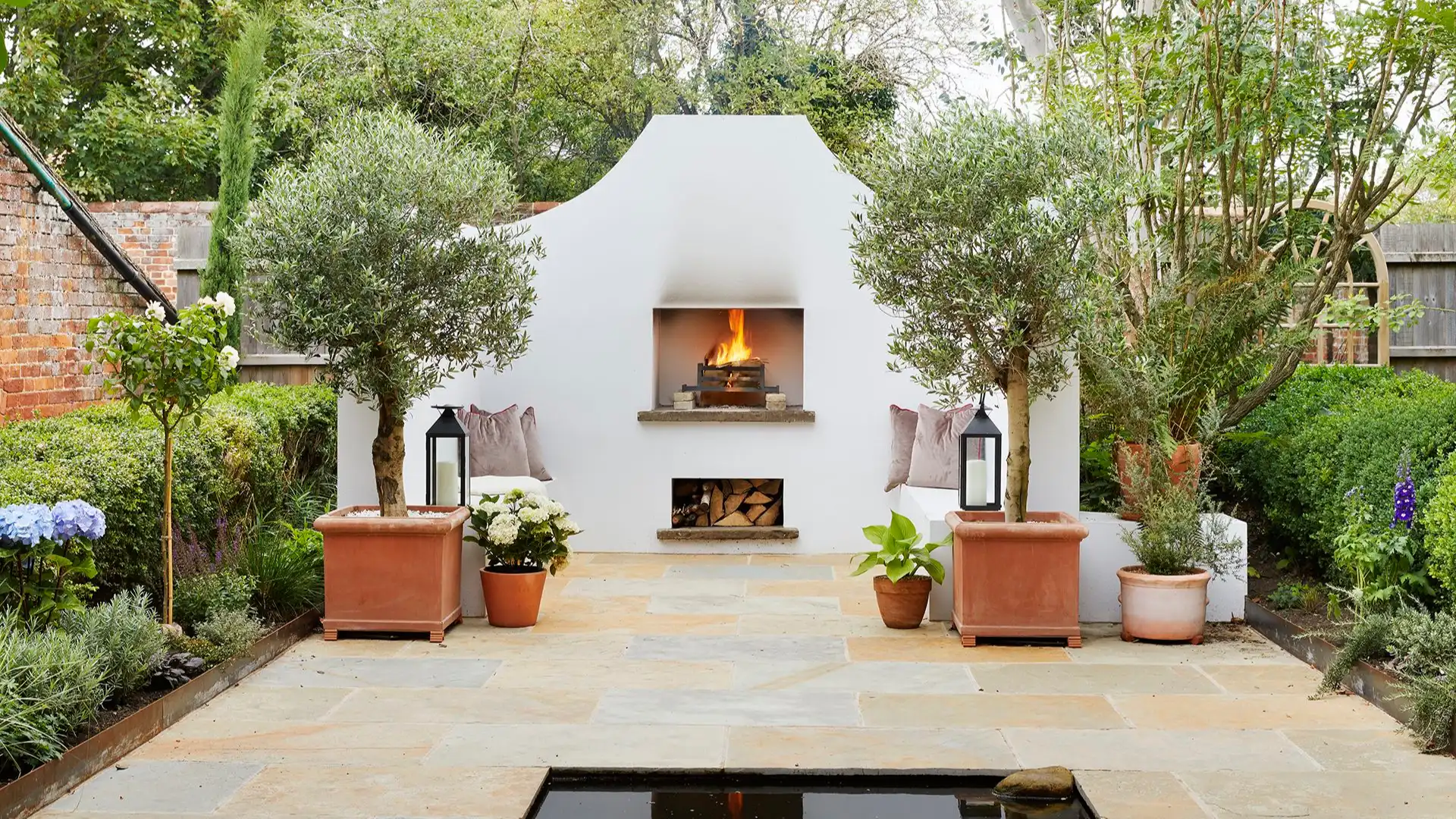
Few spatial compositions capture the imagination of architects and aesthetes quite like the Greek island courtyard design. At once elemental and sophisticated, these open-air sanctuaries distill centuries of Mediterranean living into a restrained dialogue between shade, whitewashed walls, and the deliberate placement of seating. Within their modest footprints, they achieve something extraordinary: a seamless fusion of climate intelligence, social ritual, and architectural poetry.
Across the Cyclades, the Dodecanese, and Crete, whitewashed outdoor spaces glow under an unrelenting sun, while pergolas, canvas sails, and climbing vines temper light into dappled shadow. In these courtyards, furniture is never incidental. The choreography of Mediterranean courtyard seating defines movement, frames views, and anchors the sensory experience of wind, scent, and stone. For designers, developers, and discerning homeowners, these lessons offer enduring guidance for contemporary shaded patio ideas rooted in place and proportion.
The Cultural DNA of the Greek Island Courtyard
The courtyard in Greek domestic architecture is not an accessory but a spatial nucleus. Historically, it functioned as a climatic regulator, social stage, and contemplative retreat. In dense island settlements such as Mykonos and Paros, homes cluster tightly along winding lanes, turning inward to private open-air rooms that balance exposure with enclosure.
This inward orientation shapes the essence of Greek island courtyard design. High, lime-washed walls shield inhabitants from wind and sun, while allowing breezes to circulate. The result is a microclimate that moderates temperature without mechanical intervention—an approach increasingly relevant in sustainable design discourse.
The aesthetic is deceptively simple:
- White or pale mineral finishes that reflect light and reduce heat gain
- Stone or terrazzo paving that cools underfoot
- Built-in benches carved from masonry
- Strategic openings that frame sea or sky
According to the UNESCO World Heritage Centre, the vernacular architecture of the Aegean exemplifies adaptive responses to climate and topography—principles that continue to inform contemporary interpretations of whitewashed outdoor spaces.
White Walls as Light Sculptors
The Power of Whitewashed Outdoor Spaces
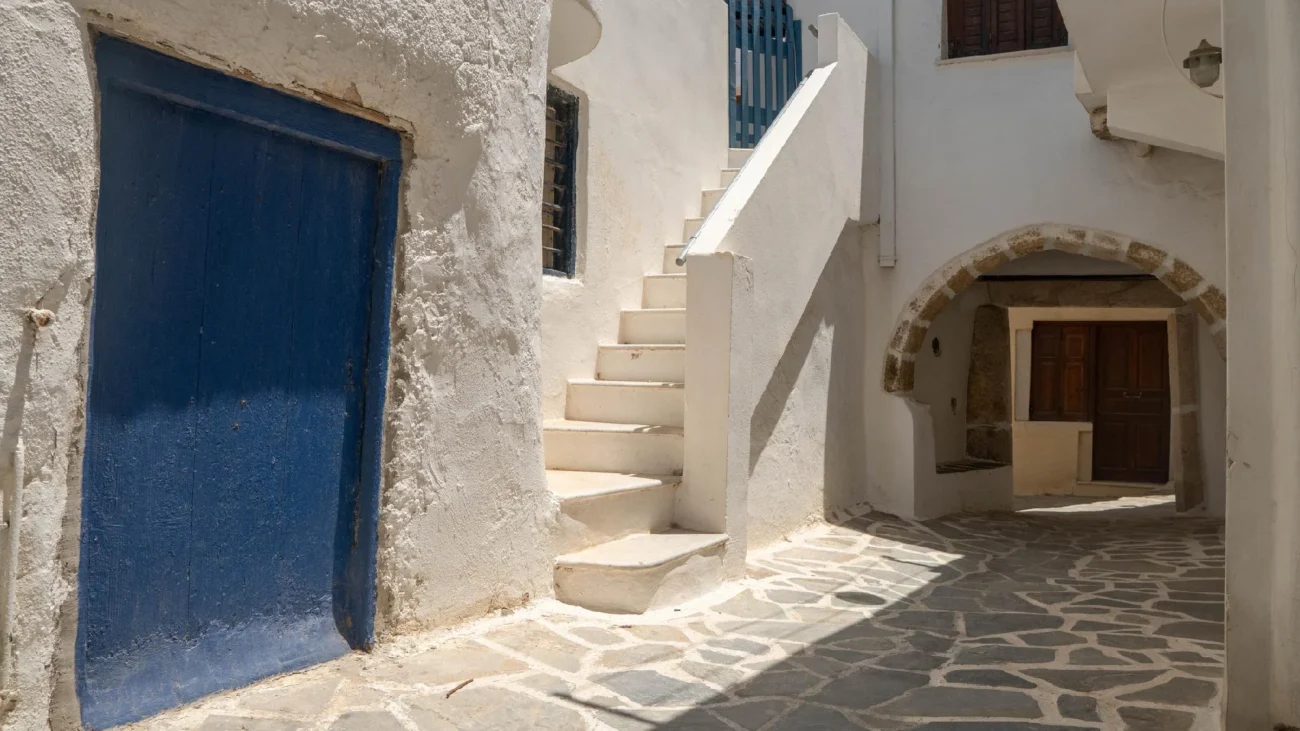
The luminous quality of whitewashed outdoor spaces is not merely aesthetic; it is environmental strategy rendered beautiful. Lime wash, traditionally composed of slaked lime and water, offers breathability, antibacterial properties, and high solar reflectance. Under the intense Mediterranean sun, white walls diffuse light rather than absorb it, softening glare and amplifying the interplay of shadow.
For architects, this chromatic restraint creates a neutral canvas against which texture and form become paramount. Rough plaster, exposed stone lintels, and wooden pergola beams stand in sculptural relief. In the context of Greek island courtyard design, white is less a color than a medium—an instrument for shaping atmosphere.
Shadow as Architectural Material
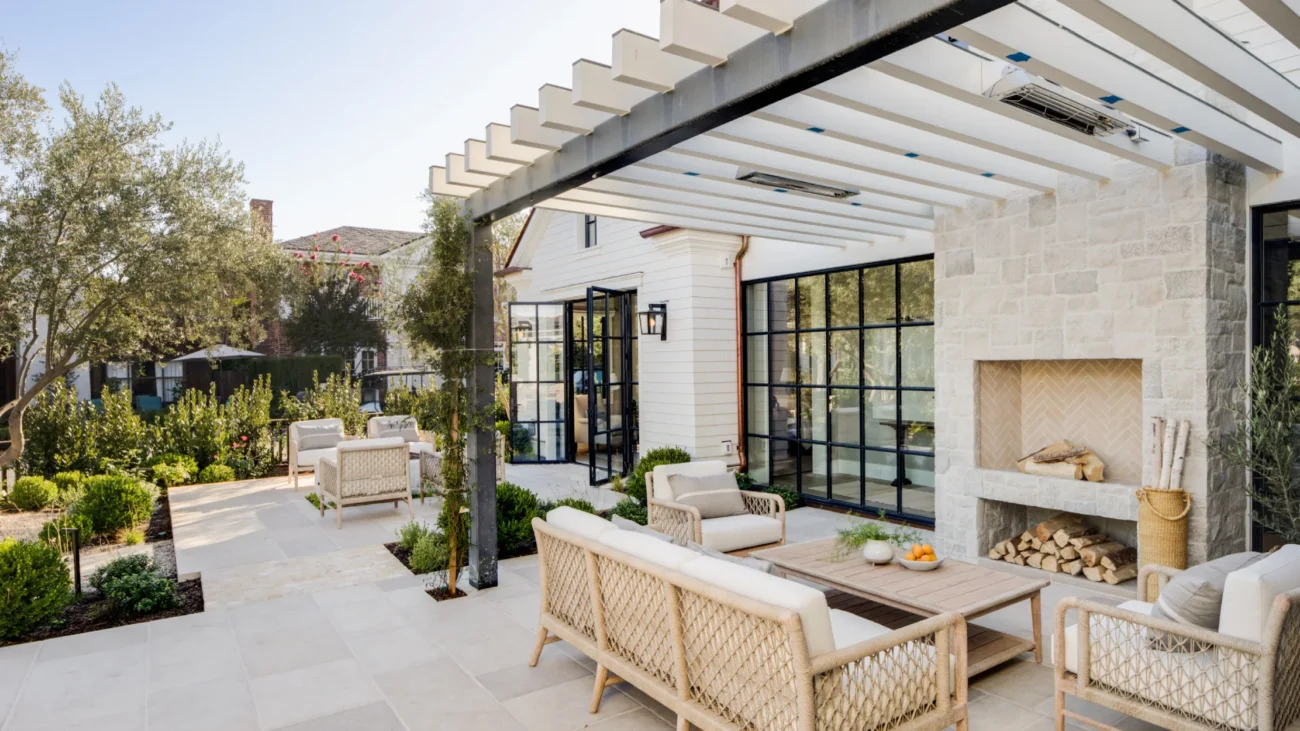
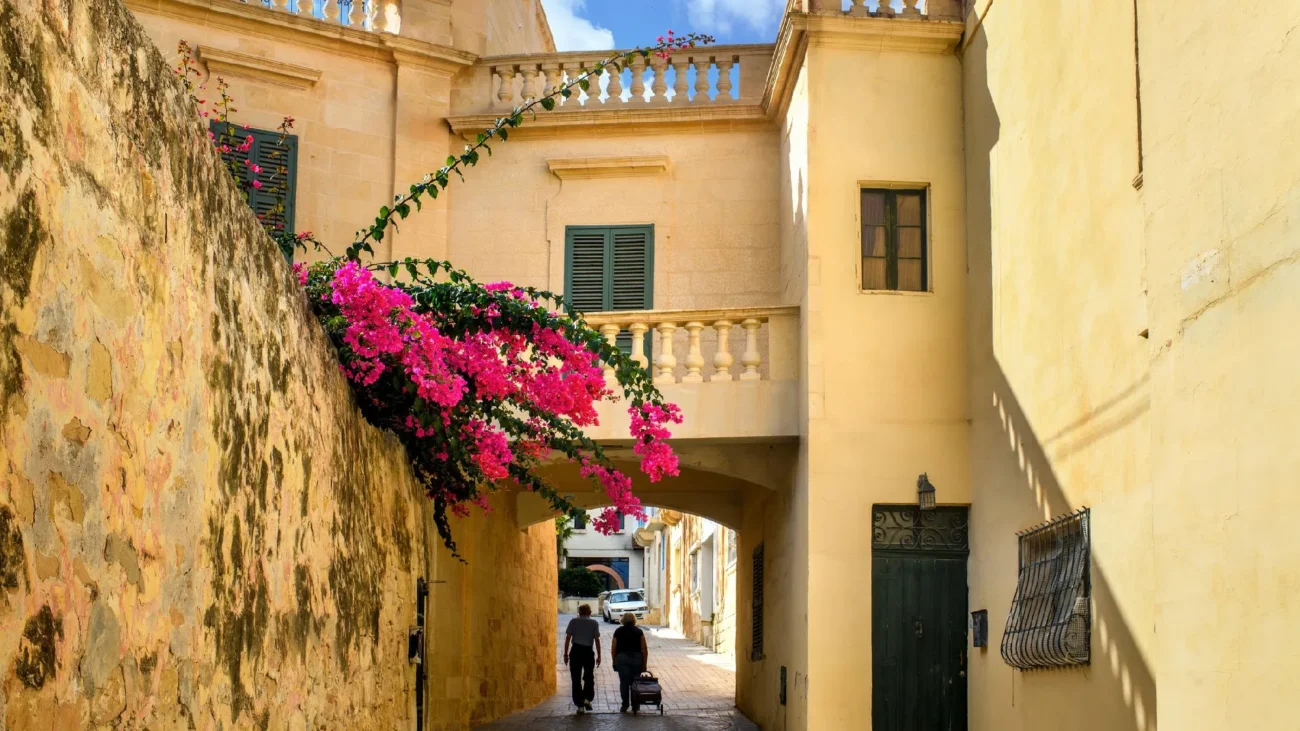
Shade defines the emotional temperature of the courtyard. Whether cast by a pergola, woven reed canopy, or climbing bougainvillea, shadow introduces rhythm and depth. Designers seeking refined shaded patio ideas can study the Greek model, where:
- Overhead structures are light and permeable rather than heavy and opaque
- Textiles are neutral—linen, canvas, or sailcloth—to preserve tonal harmony
- Vegetation is used sparingly but strategically for filtered shade
In this interplay of white and shadow, Mediterranean courtyard seating emerges as both focal point and refuge, positioned where light is tempered but views remain uninterrupted.
The Placement of Seating: Geometry, Hierarchy, and View
Built-In Versus Freestanding
In traditional Greek island courtyard design, seating often begins as architecture. Masonry benches, integrated into perimeter walls, provide thermal mass and permanence. They define edges and encourage communal gathering. Cushions in muted earth tones soften their austerity without competing with the clarity of whitewashed outdoor spaces.
Contemporary interpretations introduce sculptural freestanding pieces—low-profile loungers, teak armchairs, and modular sofas—yet the principle remains consistent: seating must respect the geometry of the courtyard. In exemplary Mediterranean courtyard seating layouts, furniture aligns with walls or axes rather than floating arbitrarily.
Orienting Toward the Horizon
On islands where sea and sky dominate, the placement of seating often acknowledges distant views. Even in enclosed courtyards, a framed aperture—a doorway, arch, or elevated terrace—guides the eye outward. The most compelling shaded patio ideas adopt this approach, positioning seating to:
- Capture prevailing breezes
- Maximize morning or evening light
- Frame a focal element such as an olive tree or water feature
In this sense, Greek island courtyard design becomes an exercise in editing. What is seen, and from where, is carefully orchestrated.
Material Intelligence and Sensory Design
Stone, Wood, and Textiles
Materiality underpins the authenticity of whitewashed outdoor spaces. Local stone—granite in the Cyclades, limestone elsewhere—anchors the courtyard to its terrain. Timber beams, often left raw or lightly oiled, introduce warmth. Textiles remain restrained, favoring natural fibers that age gracefully under sun exposure.
For professionals developing high-end residences, these cues translate into contemporary Mediterranean courtyard seating schemes that prioritize:
- Durable, UV-resistant upholstery in mineral hues
- Low-slung profiles that maintain visual openness
- Organic finishes that patinate rather than deteriorate
The success of Greek island courtyard design lies in this balance between permanence and softness, structure and comfort.
Acoustic and Olfactory Layers
Beyond the visual, courtyards engage the senses through scent and sound. Jasmine, rosemary, and citrus trees introduce subtle fragrance, while gravel or stone surfaces modulate acoustics. In refined shaded patio ideas, a small fountain may provide gentle ambient noise, enhancing privacy in dense urban contexts.
Within whitewashed outdoor spaces, these sensory layers gain clarity. The restrained palette allows aroma, texture, and airflow to become perceptible, enriching the experience of Mediterranean courtyard seating arrangements designed for lingering conversation.
Climate Adaptation and Sustainable Luxury
As climate resilience becomes a defining concern in global architecture, the lessons of Greek island courtyard design feel prescient. Thick walls, shaded patios, and cross-ventilation reduce reliance on mechanical cooling. White surfaces mitigate urban heat island effects. Courtyards foster social interaction without energy-intensive interiors.
For luxury real estate developers, integrating whitewashed outdoor spaces within modern villas offers both aesthetic distinction and environmental performance. Thoughtful Mediterranean courtyard seating configurations further encourage outdoor living, effectively expanding usable square footage while lowering energy demand.
Among the most relevant shaded patio ideas inspired by Greek precedents are:
- Retractable fabric pergolas that adjust to seasonal sun angles
- Deep-set loggias adjoining central courtyards
- Green roofs that enhance insulation and reduce glare
These strategies reinterpret tradition without resorting to pastiche, aligning heritage with contemporary sustainability metrics.
Spatial Proportion and Human Scale
The Courtyard as Outdoor Room
One of the defining attributes of Greek island courtyard design is its intimate scale. Rarely monumental, these spaces feel protective and human-centered. Proportions are calibrated so that walls neither overwhelm nor expose. This sense of enclosure is critical to successful whitewashed outdoor spaces in any climate.
When designing Mediterranean courtyard seating, scale should correspond to the architecture. Oversized sectionals may disrupt balance, while slender, well-proportioned pieces maintain harmony. Designers can consider:
- Seating heights that align with low parapet walls
- Coffee tables in stone or ceramic that echo paving materials
- Layered cushions that introduce texture without visual clutter
Such calibration elevates even modest shaded patio ideas into refined outdoor salons.
Translating Greek Island Courtyard Design Beyond the Aegean
While deeply rooted in place, the principles of Greek island courtyard design adapt remarkably well to diverse geographies—from California to the Middle East, from Australia to Southern Europe. The key lies in translating essence rather than imitating form.
To achieve authentic whitewashed outdoor spaces abroad:
- Respect local materials and craftsmanship
- Respond to specific sun paths and wind patterns
- Maintain tonal restraint and architectural clarity
Similarly, Mediterranean courtyard seating should reflect contemporary lifestyles while preserving the ethos of simplicity. In global luxury contexts, this often means modular, weather-resistant pieces arranged with architectural discipline.
The enduring appeal of these shaded patio ideas lies in their universality. They prioritize comfort without excess, elegance without ostentation.
The Enduring Intelligence of Shade and Simplicity
In an era of visual saturation and architectural spectacle, the quiet authority of Greek island courtyard design offers a compelling counterpoint. Through the disciplined use of whitewashed outdoor spaces, the strategic cultivation of shade, and the intentional placement of Mediterranean courtyard seating, these environments demonstrate that luxury can be both restrained and deeply experiential.
For architects, designers, and real estate visionaries, the lesson is clear: the most powerful shaded patio ideas are those grounded in climate, culture, and human scale. In the luminous courtyards of the Greek islands, we find not a trend, but a timeless blueprint for outdoor living—one where light is sculpted, seating is choreographed, and simplicity becomes the ultimate sophistication.